Thursday, July 30, 2020

New Mazda MX-5 R-Sport 2020 review

https://ift.tt/3jQmt0C

Verdict

The limited-run MX-5 R-Sport’s cosmetic extras add some exclusivity, but while it looks great, the real attraction here is what makes every MX-5 so appealing. The involving handling, a powertrain you have to push but can really revel in exploiting, great style, and the option to drop the convertible roof make this special-edition soft-top one of the best yet from Mazda.

There must be more special editions of the Mazda MX-5 than pretty much any car ever sold. That’s because this icon has been on sale continuously for more than three decades, and with more than a million examples shifted, it’s the world’s best-selling two-seat roadster.

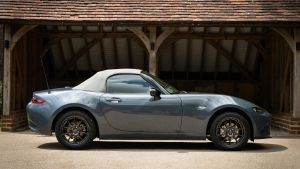
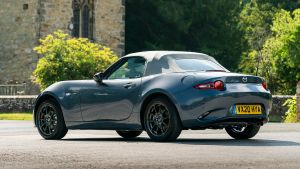
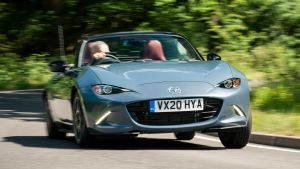
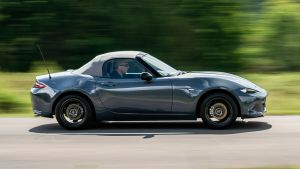
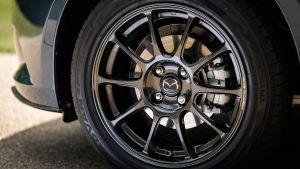
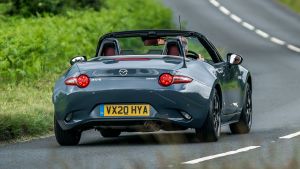
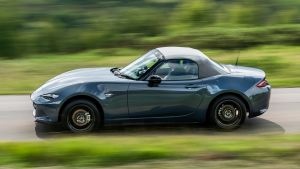
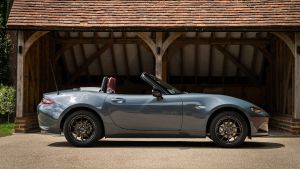
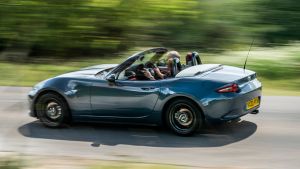
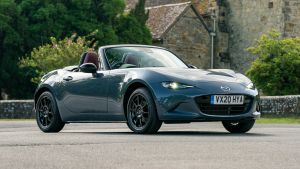
Now there’s another special edition, called the MX-5 R-Sport, and it’s a peach. Priced from £27,700, it’s limited to just 150 examples and features Polymetal Grey metallic paint, some smart 16-inch Rays alloy wheels finished in gloss black and a special silver-grey colour for the fabric convertible roof.

This car is based on the 1.5-litre MX-5, which is lighter than the 2.0-litre version and so pure to drive. It has ‘just’ 130bhp – there are no turbos here – so you really have to work the engine and superb six-speed manual gearbox to make the most of what’s on offer. But this is the joy of driving an MX-5 and it’s reinforced in the R-Sport.

The engine doesn’t have any steps in its power delivery, revving smoothly and with a rasp to its limiter. It’s noisy and sometimes not that refined, but then this is also part of the engine’s appeal.

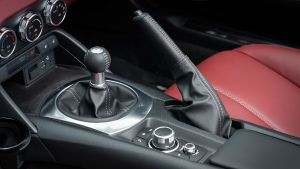
With only 152Nm of torque, you have to keep on top of the gearbox, but the level of interaction through the stubby lever and its direct, mechanical-feeling shift action means it’s great fun doing so.

The steering is similarly involving. It’s on the light side, but then, with relatively skinny front tyres and a weight of around a tonne, that’s not surprising. The steering feels delicate and offers good feedback.

The chassis is as communicative too; there’s quite a bit of roll, more than you might expect in a sports car, but this does allow some weight transfer to push the tyres into the tarmac and maximise grip, while leaving you to enjoy the chassis balance and exploit the car’s rear-drive layout without it feeling snappy or unpredictable.

The other benefit is that the ride is relatively comfortable for a small, light two-seater. You do get bumped around a bit on country roads, but this connection with the MX-5 and what it’s doing all of the time is the essence of the experience.

With the roof down, there’s some noticeable shaking of the structure over bad roads, but this is far from a carbon-fibre convertible supercar – and at such an affordable price for such an involving machine, the R-Sport is still great value.
image
image
image
image
image
image
image
image
image
image
image
image
image
image
image
image
image
image

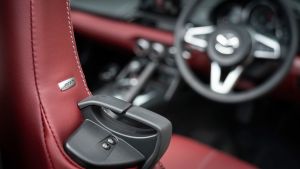
That hood folds manually, but with one catch, it’s so simple to do, even on the move. It’s just as quick and easy to put back up in case you get caught in a shower.

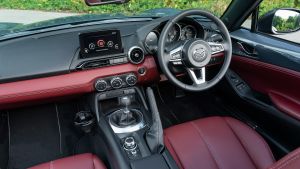
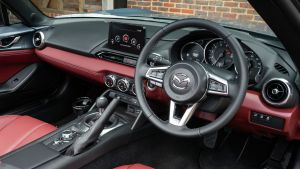
R-Sport spec also adds burgundy Nappa leather trim inside, which really sets the cabin off. It looks great and gives a premium feel; given that this fourth-generation ‘ND’ MX-5 has been on sale for five years now and has only received a few updates in that period, the basic cabin layout still looks surprisingly good and works well.

It’s slightly cramped for taller drivers, but even at six feet tall, you should be able to find a comfortable enough driving position.

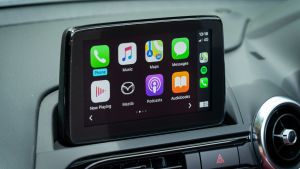
Over time, Mazda has updated the MX-5’s tech, so there’s now Apple CarPlay and Android Auto phone connectivity, as well as the usual sat-nav. You also get cruise and climate control, heated seats, autonomous braking, lane-departure warning, a Bose stereo and keyless operation. The MX-5 is compact and visibility is relatively good, so you don’t need features such as parking sensors or a reversing camera.

The lack of mass and the smaller engine (compared with the 2.0-litre model) mean it’s relatively efficient, returning claims of 44.8mpg and 142g/km. But the MX-5’s usual flaws still remain, so along with the slightly cramped cabin, there’s only 130 litres of boot space. It’s enough for two bags – just – but the opening is small.

Model: Mazda MX-5 R-Sport
Price: £27,700
Engine: 1.5-litre 4cyl petrol
Power/torque: 130bhp/152Nm
Transmission: Six-speed manual, rear-wheel drive
0-62mph: 8.3 seconds
Top speed: 127mph
Economy: 44.8mpg
CO2: 142g/km
On sale: Now


from Sitewide RSS feed https://ift.tt/313mqpA

New Mazda MX-5 R-Sport 2020 review - pictures

https://ift.tt/eA8V8J

Pictures of the new Mazda MX-5 R-Sport

from Sitewide RSS feed https://ift.tt/3gqkjCZ

Wednesday, July 29, 2020

Your electric car questions answered - the ultimate EV and hybrid FAQ guide

https://ift.tt/eA8V8J

Few areas of automotive development have progressed as quickly as the move to electrification. Hybrid, plug-in hybrid (PHEV) and fully electric cars and vans no longer represent an interesting niche; they’re now firmly part of the motoring landscape. 

It’s not hard to see why, either. With a wide range of models, and a number of different powertrains, switching to electrified transport has never been easier for consumers. High numbers of them seem to agree, too: almost 38,000 fully electric new cars took to the roads in 2019 – an increase of 144 per cent on 2018. 

These figures will continue to grow. The government’s goal is to ban the sale of new non-hybrid petrol and diesel cars by 2040, but it’s considering bringing this date forward. The European Union is also financially incentivising car makers to increase sales of plug-in cars, and legislation to clean up local air pollution will make it harder and more expensive to drive non-EVs in towns and cities.

Doom and gloom? Far from it. There are about 11,500 public charging locations in the country, with some 32,000 connectors, which means few EV owners will be far from one. And government incentives make it cheaper than ever to install a home charger, so you’ll have a full charge every morning. The plug-in car grant offers as much as £3,000 towards your next car, too.

An electric car or plug-in hybrid might not suit your lifestyle right now but with the landscape changing so quickly, it’s likely that one soon will. Of course, it’s a completely unfamiliar technology to many people and as electric cars become more relevant, there are more questions that consumers need answering.

This raises a whole host of questions for motorists thinking about buying and electric car or already running one and this guide to the key electric car questions is here to help. We cover everything from charger types and speeds, running costs and government grants to whether you can tow your caravan. 

Click the links below and we’ll answer all your electric car and plug-in hybrid questions for you...


from Sitewide RSS feed https://ift.tt/2X5YQHA

Can you tow with an electric or hybrid car?

https://ift.tt/eA8V8J

Camping and caravanning are popular pastimes, but if you plan on using an electric car to tow your trailer tent or caravan, you need to tread carefully. Most electric cars are not type-approved for towing and the towing capacities of those that can officially tow trailers vary greatly from model to model.  

A few electric cars are rated to tow as much as equivalent petrol or diesel cars and the abundant torque generated by electric motors makes them adept in the tow car role. It's a similar story with plug-in hybrid models which are far more likely to be approved for towing and have similar advantages in terms of pulling ability. 

If towing is a major part of your motoring life you needn't exclude electrified vehicles completely from your shopping list, but make sure you do your research before taking the plunge so that you fully understand what each vehicle can tow safely and legally before you buy.

Why are many electric cars not suitable for towing a caravan?

There are several reasons why electric cars aren't approved to tow or can't tow very much, but the biggest one is type approval: a process that every model has to go through before it can be sold. In that process, makers decide whether to approve the vehicles for towing or not – and many electric cars simply aren’t approved for towing.

There are some very good reasons for this. Chiefly, the extra weight of a caravan could cause the car’s motors and brakes to struggle. Electric cars are already heavier than conventional vehicles, placing more strain on some parts, and a speedboat hitched on the back would add to this. Then there is the issue of regenerative braking systems which slow electric cars quickly to recapture kinetic energy as electricity and charge the battery. The more extreme settings of these systems might cause a trailer to behave in an unexpected way when the car slows as a result of the driver lifting off the throttle. 

What's also certain is that hitching a caravan on to the back of an electric car will reduce the car’s overall potential range significantly.

As a result of all this, towing capacities for electric cars vary greatly. Very few electric vehicles are certified for towing very heavy caravans or trailers. The Tesla Model X is an exception as this SUV can tow an impressive 2,270kg, and Tesla has built it with a ‘trailer mode’, which shuts off some of the car’s drive-assistance features that wouldn’t work as well with a trailer. An Audi e-tron can manage a respectable 1,600kg, a Jaguar I-Pace can tow 750kg and there are other electric car options out there that can also tow.  

Can plug-in hybrids tow?

According to the Caravan and Motorhome Club, hybrids are the best choice for anyone who wants to use an alternative-fuel vehicle for towing a caravan. They have the best combination of performance and economy when towing.

In fact, there have been several plug-in hybrid vehicles certified for towing, including the Mitsubishi Outlander PHEV, Volvo XC90 T8, Volvo XC60 T8 and Audi Q7 e-tron.

The Volvo XC60 T8 has a 2,100kg limit, while the Porsche Cayenne e-Hybrid manages up to 3,500kg. 

Smaller models like the Audi A3 Sportback e-tron and the VW Golf GTE (now only available as used cars) can tow up to 1,600kg. And, while the Toyota C-HR and Prius hybrids are certified for towing, their limits are even smaller – just 725kg in the Prius.

Now take a look at the best plug-in hybrids on sale today...


from Sitewide RSS feed https://ift.tt/339fCtc

Electric car running costs: tax, insurance, servicing and repairs explained

https://ift.tt/eA8V8J

Although electric cars tend to be slightly more costly to buy than their conventional counterparts, they’re cheaper to run over the long term. Like petrol or diesel cars, or hybrids for that matter, electric cars need tax, insurance, servicing and repairs but the low emissions and relative mechanical simplicity of electric drivetrains help contribute to overall running costs that compare very favourably to other types of vehicle. 

Below, we examine all these areas that make up the total cost of ownership for electric cars. The other major saving comes in terms of charging and we cover the efficiency and charging costs of electric cars in detail here.  

Electric cars and vehicle tax

Fully electric cars are currently VED road tax-exempt, which can bring big savings over the years, because the tax on all other vehicles (including hybrids and PHEVs) is based on their level of carbon-dioxide (CO2) emissions.

For example, the Hyundai Kona Electric costs zero in tax, but the diesel version emits 112g/km. It costs £215 to tax initially (included in the on-the-road price) and £150 a year after that.

How much do electric cars cost to service and maintain?

As with fuel, so it is with servicing: electric vehicles generally work out cheaper to service and maintain than the equivalent petrol and diesel models, largely because they have fewer moving parts and fewer items prone to wearing out over time.

Where the real savings come is when you need to replace parts after the warranty runs out. Electric cars don’t need oil filters and have no cambelts or other items that can be fairly expensive to replace. If there are fewer parts, what do electric-vehicle services do?

Most regular service plans focus on ensuring the battery and electric drivetrain work as intended. Often, the charging cable is checked for damage, tears and performance (and will be replaced, if necessary), while the battery is also checked for charge level. This is crucial, because its performance can deteriorate over time.

All of the vehicle’s high-voltage systems and cables are also checked, with parts replaced if necessary.

Are electric cars any more expensive to insure?

While servicing, fuel and tax costs are usually cheaper for electric cars than for conventional vehicles, electric vehicles are more expensive to insure. This is partly because their repair costs are higher, and because there aren’t enough technicians in the UK trained to do the work.

Our research found we could be insured on a Hyundai Kona Electric for £648 a year. However, using the same details (42-year-old engineer, who’s married and a house owner, living in Banbury), the insurance on a diesel-engined Kona cost £612.

Can independent garages service electric cars?

Yes, in theory; but an Auto Express investigation found that less than one per cent of the UK’s 240,000 technicians are qualified to work on electric and hybrid cars; in 2017, none worked at independent garages.

Now take a look at our pick of the top 10 best electric cars on sale...


from Sitewide RSS feed https://ift.tt/39KxyvG

New 2020 Mercedes S-Class: further specs confirmed - pictures

https://ift.tt/eA8V8J

Teaser images and spy shots of the new Mercedes S-Class

from Sitewide RSS feed https://ift.tt/3372XXC

Fast charging or rapid charging? Electric car charger types explained - pictures

https://ift.tt/eA8V8J

UK electric car chargers and connection types in pictures

from Sitewide RSS feed https://ift.tt/2Epwd1y