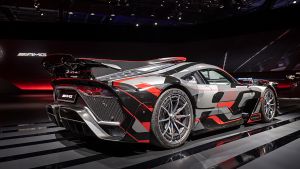
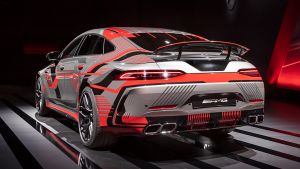
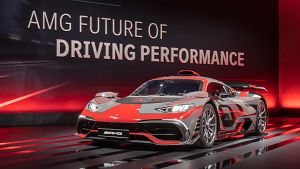
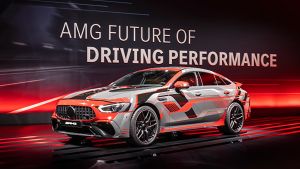
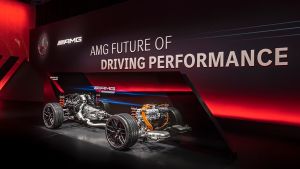
Mercedes-AMG has set out the electrified future of its performance powertrains, with two new plug-in hybrid drivetrains - the most potent of which will offer more than 804bhp and four-wheel drive.
The electrified AMG line-up will be branded under the E Performance banner and has been inspired by Mercedes-AMG’s Formula One operation, with tech transfer from race track to road helping the development. All-electric AMG models have also been confirmed.
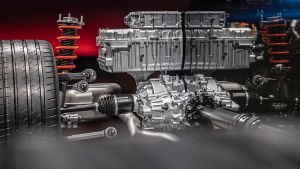
Mercedes-AMG E-Performance hybrids: engine, battery and electric motor
AMG says the new units engines both use a modular hybrid system. They employ the firm’s familiar 4.0-litre turbocharged V8, and a reworked version of the 2.0-litre four-cylinder turbocharged four-cylinder engine used in the A 45 superhatch.
These combustion units will be mated to a nine-speed AMG Speedshift transmission with what AMG calls a “fully variable” 4MATIC+ all-wheel drive system helping distribute power.
For both engines, an electric motor on the rear axle drives independently of the gearbox, allowing quicker transmission of power for stronger acceleration. The new PHEV powertrains will deliver zero emissions running over shorter distances, too.
Depending on the powertrain the electric motor can produce peak power of up to 201bhp for a maximum of 10 seconds, and 320Nm of torque. However, continuous power is rated at 94bhp.
The rear axle also features an electronically controlled limited-slip differential to help handling, while the motor drives through its own two-speed transmission. The second ratio is selected depending on driving conditions, changing up by a top speed of around 87mph, where the motor reaches its maximum speed of 13,500rpm.
The system is fed by a relatively compact 6.1kWh lithium-ion battery to help its packaging in the cars. The 400-volt unit’s 560 cells are also individually cooled, keeping the battery temperature constant for more consistent performance.
AMG says that “even during fast laps in hybrid mode on the race track, where acceleration (battery is discharged) and deceleration (battery is charged) are frequent, the energy storage system retains its high performance capacity.”
Mercedes also states that the AMG High Performance Battery tech is scalable, so that “it would also be conceivable in principle to have further expansion stages follow,” with the modular concept to be rolled out across several models in the future.
Mercedes-AMG E-Performance hybrids: power and performance
The headline figures for the 4.0-litre turbocharged V8 PHEV powertrain stand at “more than 804bhp total system power and over 1,000Nm of system torque.”
AMG says, depending on the vehicle, this delivers a 0-62mph time of less than 3.0 seconds, helped by the car’s four-wheel drive system and the immediate response of the rear-axle-mounted electric motor.
The brand has also improved the response of the combustion unit with electrically assisted turbochargers to help further reduce lag and sharpen up driver inputs with the throttle.
Mercedes says that, “The electric exhaust-gas turbocharger solves the conflict of objectives between a small, fast-responding turbocharger, which achieves comparatively low peak power, and a large turbocharger with high peak power, which in turn responds with a significant delay.”
Powered by the 400-volt battery, AMG claims the new turbo set-up makes the engine as agile as a naturally aspirated V8.
It’s expected that this V8 PHEV powertrain will launch in the brand’s forthcoming Mercedes-AMG GT73e four-door, which has recently been spied testing.
AMG has also revealed details of its other E Performance plug-in hybrid option using four-cylinder petrol power, expected to make its debut in the next BMW M3 rivalling AMG C63. The 2.0-litre four-cylinder unit will also use an electrically-assisted exhaust gas turbocharger and will produce “more than 443bhp” - combined with the electric motor’s peak output of 201bhp it means that more than 644bhp is possible.
Mercedes claims that, “The total power and the total torque enable future AMG models to achieve driving performance that even surpasses comparable, current vehicles with V8 engines without hybrid drive.” So it should be faster, more agile and more efficient than the outgoing C63.
Mercedes-AMG E-Performance hybrids: driving modes
The new hybrid system is “always on,” according to Mercedes, drawing operating logic from the brand’s F1 car so that “maximum propulsion is always available when the driver needs it.”
There are six AMG Dynamic Select driver modes to choose from though, with pre-set calibrations for the powertrain.
‘Electric’ allows zero-emissions driving at up to 80mph, which means in this mode only the rear axle drives the car. However, thanks to the mechanical connection the 4MATIC+ system brings it means the electric drive unit can also send power to the front axle if a loss of traction is detected.
When the battery is empty the system defaults to ‘Comfort’ mode. This uses both power sources but prioritises electric driving. The gearbox will upshift early when the combustion engine is on, while the steering and suspension are set up for refinement, comfort and efficiency.
‘Sport’ mode means the electric motor’s boost function is released earlier, throttle response is sharper, the gearbox will hold onto ratios for longer, changing quicker on up and down shifts, while the suspension and steering set-ups are also more direct.
‘Sport+’ takes this to another level with an even more dynamic calibration that includes “cylinder blanking” for faster upshifts and a higher engine idle to help with quick getaways.
‘Race’ mode maximises performance, with the e-motor’s full performance available alongside the combustion engine. The battery is also recharged more aggressively to maximise the assistance available from the system too.
Finally, ‘Individual’ allows drivers to tailor these parameters - engine, transmission steering, suspension and exhaust sound - to their desired settings.
AMG Dynamics variable traction control settings also feature, with Basic, Advanced, Pro and Master modes linked to the different drive parameters mentioned above. These settings tune the ESC system and the car’s handling balance, with the electric motor working to reduce ESC intervention.
There are four stages of energy recuperation for AMG’s new plug-in hybrid powertrains, ranging from Level 0 to Level 3.
Level 0 means the car behaves in a similar way to a combustion engined car coasting along with the clutch disengaged, so regenerative braking is low.
Level 1 is the standard setting and feels like regular engine braking, Level 2 ramps this up and Mercedes says that “the brake pedal hardly needs to be depressed when moving in traffic.”
Level 3 delivers the most energy recuperation, with one-pedal driving possible, like in an EV.
Mercedes-AMG E-Performance hybrids: hot EVs on the way
AMG has also confirmed that performance versions of Mercedes’ electric EQ models are on the way.
These will be badged 43 and 53, and “are ambassadors for a new era in the performance segment,” according to the brand.
These cars will feature AMG-specific styling cues, with vertical louvres for the radiator grille, a new front apron design, a different spoiler and diffuser, plus a choice of AMG alloy wheels. The interiors will receive a sporty makeover too, with many AMG touches.
The twin-motor four-wheel drive powertrains will offer performance on a par with the current most potent V8 biturbo AMG cars. This means 0-62mph will take “well under 4.0 seconds” while top speed stands at 155mph.
Details of the 400-volt battery’s capacity have not been revealed, but the brand says the wiring has been upgraded to handle the extra power demands of an AMG.
Sound is a key part of any AMG package, and to break the electric silence the firm is developing an “AMG Sound Experience” that uses the car’s speakers, a shaker and a sound generator to develop a sound signature for its performance EVs.
Volkswagen has confirmed that it will not rebrand its US operations as “Voltswagen” despite adamant claims from the company, which publicised the move as genuine.
The timing of the initial announcement raised questions about its legitimacy, as it was only days before April Fools’ Day. Volkswagen issued a press release on 29 March, which was quickly followed by an official statement, both of which confirmed the rebrand as genuine.
According to the company’s release, the rebrand would only apply to electric Volkswagen models sold in the US, rather than the wider North American market. The “Voltswagen” name, it said, will appear on the company’s EVs alongside a new light blue badge, with the dark blue VW roundel reserved for combustion-engined vehicles.
The announcement was apparently timed to coincide with the launch of the ID. family of electric vehicles in the US. The ID.4 SUV is about to go on sale there as Volkswagen’s first US-market MEB-based electric vehicle, as the firm doesn’t offer the smaller ID.3 hatchback that’s already on sale in Europe.
Numerous US media outlets quickly latched onto the proposed rebrand, ranging from automotive media to national news providers, all of which confirmed the move as true. The Volkswagen America PR team were in on the joke, too, and kept the illusion going with serious-looking quotes from high ranking company officials.
In particular, Scott Keogh, Volkswagen America’s president and CEO, released a statement which read:
“We might be changing out our K for a T, but what we aren't changing is this brand’s commitment to making best-in-class vehicles for drivers and people everywhere.
“The idea of a ‘people’s car’ is the very fabric of our being. We have said, from the beginning of our shift to an electric future, that we will build EVs for the millions, not just millionaires. This name change signifies a nod to our past as the peoples’ car and our firm belief that our future is in being the peoples’ electric car.”
Volkswagen’s US marketing vice president, Kimberly Gardiner, also said: “Over the course of the next few months, you will see the brand transition at all consumer touch points. This is an exciting moment for us, and we have been working through every avenue to make the transition clear, consistent, seamless and fun for all.”
However, the facade soon crumbled as, on 30 March, the Reuters news agency quoted three internal sources at Volkswagen who confirmed the move was nothing more than a marketing stunt, and that the company had planned to wait until April Fools’ Day before making the joke announcement.
Car manufacturers are better versed than most in making hoax press releases on April Fools' Day, but they’re usually very easy to spot or clearly labelled as such, and reserved for the day itself. The confusion around Volkswagen’s efforts this year stems from the leak and the subsequent efforts from the PR team to keep the joke running until the big day.
Now check out our run-down of the best car-based April Fools’ jokes from years gone by, by clickinghere…
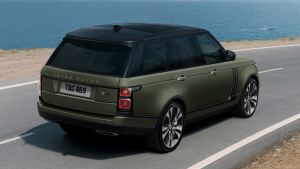
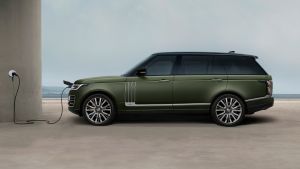
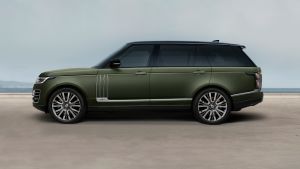
A pair of exclusive Range Rover SVAutobiography editions have joined the line-up as Land Rover’s flagship models, with a “suite of complementary hand finished SV bespoke features,” according to the brand.
These two new models elevate the SVAutobiography and SVAutobiography Dynamic models further still, showcasing the range of personalisation options that is on offer to customers looking for the best of the best in luxury SUVs.
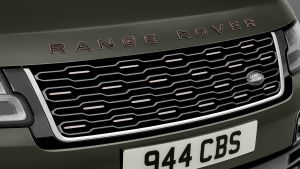
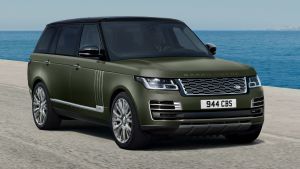
From the outside, the SVAutobiography Ultimate models can be distinguished by their new satin-finish Orchard Green paintwork and Navarik Black contrasting roof, with copper detailing picking out highlights. Created by Land Rover’s SV Bespoke team, the models also wear gloss black copper-edged Range Rover badges on their bonnet and tailgate, setting them apart from other models in the line-up.
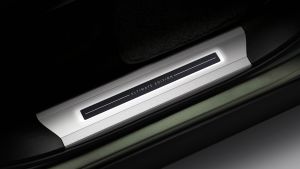
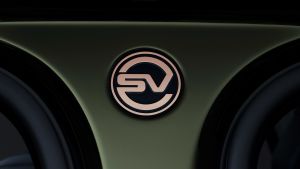
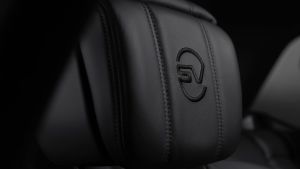
There’s more copper-themed badging, with copper-plated SV roundels on the cars’ B-pillars, embroidered SV roundels on all four headrests inside, and illuminated ‘Ultimate edition’ treadplates on the interior door sills.
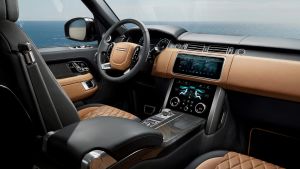
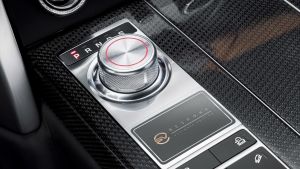
Finally, each car wears a ‘SV Bespoke Ultimate edition’ commemorative plaque on the centre console inside, with yet another copper-finished SV roundel.
There’s a choice of powertrains available - either the 557bhp 5.0-litre supercharged V8, or the 398bhp P400e plug-in hybrid, which combines a 2.0-litre turbocharged four-cylinder petrol engine with a battery pack and electric motor for a zero-emission range of 25 miles and CO2 emissions as low as 75g/km.
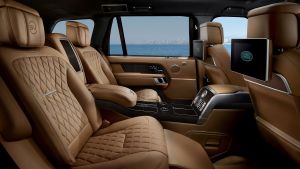
This long wheelbase flagship features power closing rear doors, reclining business class seats in the rear that are both heated and cooled, a hot stone massage function, calf and foot rests, and a total of 1.2 metres of rear legroom.
There’s also a full-length centre console with what Land Rover calls an integrated “Zenith timepiece,” plus a fridge and fold-out tables for passengers to work on the move.
Buyers can also opt for the SVAutobiography Dynamic model, which is the more driver-focused option of the two. However, it only comes with the V8 motor and in standard wheelbase form, but in keeping with its more driver-centric approach, this car’s steering and suspension geometry have been tweaked to improve agility.
It also features an 8mm lower ride height for the air suspension set-up, while the Dynamic Response active anti-roll system helps to keep the car flatter during cornering and should increase composure in high-speed bends.
The SVAutobiography Dynamic comes with a few bespoke details too, carving it out as the sportier option of the pair of Ultimate editions.
These upgrades include 22-inch five-spoke alloy wheels finished in gloss dark grey with a diamond turned finish. There are more details finished in Atlas Grey too, while inside the knurled finishing continues for the rotary gear selector, starter button and pedals. The gear shift paddles are anodised in red, which Land Rover claims underlines the car’s performance focus.
Land Rover is also offering ‘recommended specs’ on the two models, while customers can of course personalise the pairing with myriad customisation options.
Do so and the price should rise from the already steep starting price for the £147,441 starting price for the SVAutobiography Dynamic, while the long-wheelbase SVAutobiography V8 starts from £183,706.
Speaking on the unveiling of the brace of Range Rover SVAutobiography Ultimate editions, Mark Turner, Commercial Director, Land Rover Special Vehicle Operations said: “Range Rover has defined the luxury SUV segment for more than half a century, with our SVAutobiography models offering customers a world-class travel experience – whether driving, or being driven. These new Ultimate editions elevate that refinement and sophistication even further.”
BMW has lowered the i3’s starting price to £33,805, to ensure that its electric hatchback continues to comply with the new plug-in car grant.
The change in price takes the both versions of the i3 beneath the £35,000 threshold to qualify for the grant - it stood at £50,000 before the changes earlier in March.
The decision ensures UK customers will still receive a discount for buying the pure-electric BMW i3, although the amount of government cash-back has dropped from £3,000 to £2,500 as part of the legislative change.
BMW says the i3’s level of standard equipment hasn’t changed as part of the price revision, meaning buyers will still get 19-inch alloy wheels, LED headlights, parking sensors, heated front seats and a 10-inch infotainment system with Apple CarPlay and Android Auto.
The entry-level i3 is powered by a 44.2kWh battery pack and a 168bhp electric motor mounted on the rear axle. BMW says the system will cover up to 190 miles between charges and offer a 0–62mph time of 7.3 seconds.
When connected to an 11kW AC Type 2 charger, the i3’s battery pack will recover an 80 percent charge in three hours and twelve minutes. The EV also supports 50kW DC rapid charging, which will top the battery up to the same level in 42 minutes.
BMW has also cut the price of range-topping i3s from £39,105 to £34,805 as part of the restructure, meaning it is also eligible for the new grant.
The i3s features the same battery pack as the entry-level model, but it has a more powerful 181bhp electric motor. Thanks to the extra grunt, the EV’s maximum range falls to 175 miles, but its 0–62mph time is improved to 6.9 seconds.
Like the entry-level car, the flagship model hasn’t had any equipment removed, despite the new, lower price. Buyers still receive 20-inch alloy wheels, lowered sports suspension, a slightly wider track, flared wheel arches and dedicated trim inlays for the front bumper.